As I wrote in Recruiting a new Head of School, no task is more important for a school board than choosing the right Head to fill a vacancy.
Boards of independent and international schools tend to use one of two approaches to search for a new Head of School. Many schools, particularly those in the premium or high-profile tiers, engage large recruitment firms (often called search firms or placement agencies) for Head of School (HoS) recruitment. Common examples include Search Associates, International Schools Services (ISS), Schrole, Spencer Stuart, Egon Zehnder, Russell Reynolds Associates and Carney, Sandoe & Associates, which handle leadership searches globally, including for international schools. These firms often manage large candidate databases, host recruitment fairs, and process high volumes of applications.
Other schools prefer an alternative approach, which is to engage a specialised consultant who typically has direct experience as a former Head of School and/or board member with a high level of governance expertise. Consultants such as Optimal School Governance exemplify this approach, drawing upon consultants who are former Heads of School and Board Chairs, thus focussing on tailored, mission-focussed searches rather than high-volume placements.
There are advantages and disadvantages inherent in both approaches.
Benefits of using large recruitment companies include the following:
- Extensive candidate pools and global reach: Large recruitment firms maintain vast databases and networks, attracting applicants from around the world. They can cast a wide net, reaching individuals who might not be actively looking for a new role or who are outside typical educational circles. Even though only a tiny proportion of the applicants on these databases will be active or viable candidates, the sheer number of people in the database reassures many board members that a truly extensive search is being undertaken.
- Efficiency and scale: Large recruitment firms handle advertising, initial screening, logistics (such as recruitment fairs or virtual events), as well as administrative tasks that save time for busy boards.
- Established processes: Large recruitment firms employ sophisticated search methodologies, including detailed needs assessments, competency-based interviewing, psychological profiling, and rigorous reference checking. Their processes are often well-established and designed to identify top-tier leadership talent across a wide range of various, but usually non-educational, industries. For example, a firm might use a proprietary leadership assessment framework to evaluate candidates against a school’s specific list of desired leadership competencies.
- Market intelligence and benchmarking: Large recruitment firms have access to extensive market intelligence regarding remuneration packages, industry trends, and leadership benchmarks. This can help schools structure competitive offers and understand where they stand in the competitive market.
- Visibility: Schools can gain exposure through the reputation and marketing of large recruitment firms to potential candidates.
Problems and shortcomings of using large recruitment companies that schools report include the following:
- Lack of profound educational sector understanding: Most large, generalist recruitment firms lack a deep understanding of the unique complexities, culture, and specific demands of school leadership and education as a whole. Their lack of understanding of school cultures is expressed in three main ways:
- Misinterpreting school culture and mission: Large recruitment firms often struggle to discern the subtle nuances of a school's mission, values, and community culture, leading to candidate shortlists that are technically competent but not a good cultural fit. A candidate who excels according to corporate criteria is unlikely to understand the intricacies of directing teachers, managing student welfare, or engaging with parents within a school setting.
- Evaluating educational leadership: Assessing genuine educational leadership, pedagogical vision, curriculum development experience, and understanding of diverse learning needs is vastly different from evaluating leadership in a non-educational context. As many members of school boards have discovered to their disappointment, large recruitment firms sometimes prioritise general management skills over specific educational acumen.
- Governance blind spots: Many large recruitment firms lack experience with the unique governance structures and compliance demands of independent and international schools such as parent-elected boards, foundation boards, etc, which require specific skills in board relations, communication, and strategic leadership within a non-profit educational context.
- Generic candidate profiles: Due to their broader focus and the tendency to use junior staff to conduct routine initial filtering, generalist firms often over-rely on generic, pre-prepared leadership profiles rather than exploring the specific characteristics that will enable an appointee to enhance the school’s unique mission and vision. In such cases, large recruitment firms are known to overlook candidates with unconventional but highly relevant educational backgrounds or experiences that might be a perfect fit for a specific school.
- Issues of trust: While not always specific to Head of School searches, large recruitment firms have faced criticism of their recruitment practices such as lack of transparency, complicity in biases (such as preferences for certain nationalities/passports in leadership roles), and inadequate reference checking that lead to mismatched expectations. Anonymous accounts and discussions in online forums and articles highlight how agencies sometimes prioritise speed or volume over fit, contributing to failed recruitments.
- High fees and cost-ineffectiveness: The fees charged by large international recruitment companies are substantial and often include a significant percentage of the Head of School’s first-year salary. This raises a significant conflict of interest in which the large recruitment firm is financially incentivised to persuade the board to pay as high a salary as possible to the successful applicant. Moreover, if the resulting placement is not successful due to a poor fit, this large financial investment will be wasted, leading to further disruption and cost.
- “Off-the-shelf” solutions: Schools sometimes report that large recruitment firms try to fit a school’s unique needs into an “off-the-shelf” search process rather than tailoring it precisely to their specific context. It is easy to understand how easily this can happen when a large firm feels pressured to find a place for a struggling candidate who has been in their database for an extended period of time. This tendency not only leads to a less personalised search, but it reduces the likelihood of a sound fit between the school’s unique character and the recommended applicant.
- Lack of post-placement support: While some large recruitment firms offer guarantees or limited follow-up, their involvement usually shrinks markedly once a placement has been made. Most do not provide ongoing support or help with the appointee’s induction, mentoring, coaching, or mediation in the way that a specialist educational consultant would usually offer to ensure a smooth transition and long-term success.
In stark contrast with large recruitment firms, small-scale (or ‘boutique’) consultants with specialised educational and board governance experience offer several distinct advantages that address the shortcomings of large recruitment companies, including:
- Deep Sector Knowledge and Nuance is evident in three main ways:
- Understanding of Educational Context: Small-scale specialised consultants have almost always served in leadership roles within independent and/or international schools themselves, and retain an intense passion for education. Indeed, many are former Heads of School, Deputy Heads, Board Chairs, and currently work with school boards and leaders through their wider educational consultancy services. Such consultants inevitably possess an intrinsic interest and understanding of school culture, pedagogy, student wellbeing, faculty development, and the unique challenges and opportunities in contemporary education.
- Board Governance Expertise: Drawing upon their own extensive experience, small-scale specialised consultants are almost always intimately familiar with the intricacies of independent and/or international school board governance, including strategic planning, financial oversight, fiduciary duties, the centrality of the mission and vision, and the crucial relationship between the Head of School and the Board. They can guide the Board through self-assessment and clearly articulate the governance experience required in a new Head.
- Cultural Fit Assessment: Small-scale specialised consultants’ experience allows them to conduct more nuanced assessments of a candidate’s potential cultural fit, understanding that leadership styles, communication approaches, and community engagement are paramount in a school setting.
- Tailored Search Strategy: A specialist educational leadership consultant usually develops a highly customised search strategy that genuinely reflects the unique mission, values, strategic plan, and community dynamics of the specific school. Because they have experienced school leadership at the most senior levels themselves, they can help the Board articulate a clear and compelling leadership profile that goes well beyond generic management competencies.
- Access to a Niche Network: While independent specialist consultants’ networks might be smaller than those of large recruitment firms, they are almost always more current, more specific and more relevant to the leadership needs of independent and international school communities. Specialist educational leadership consultants know who the successful leaders are, who might be ready for a move, and who would be a good fit for specific school types, whether they be K-12 schools, single-sex schools, Christian or Muslim schools, IB schools, American curriculum schools, boarding schools, and so on.
- Candidate Vetting and Evaluation: The educational background of independent specialist consultants provides the foundation for a highly informed, confidential and insightful vetting of candidates’ pedagogical philosophies, curriculum experience, experience working with school boards, and understanding of educational trends. They can ask discerning and well-informed questions to uncover authentic educational leadership capacity.
- Process Guidance and Board Development: An independent specialised consultant is well placed to provide invaluable guidance to the Board throughout the entire search process, helping them navigate potential pitfalls, manage expectations, and even facilitate board professional development to ensure they are prepared to induct and support the new Head. They can assist with crafting perceptive interview questions that reveal genuine leadership qualities specific to a school’s unique mission, vision, context, culture and ethos.
- Value: Most ‘boutique’ specialist educational leadership consultants charge an affordable, transparent fixed-fee for the search process rather than demanding a percentage of the first year’s salary of the successful applicant.
- Post-Placement Support: It is well known that independent specialist consultants offer more comprehensive post-placement support for new Heads and their Boards, including mentoring the new Head, facilitating Board-Head relations, and checking in to ensure a successful transition during the critical first year.
By necessity, this comparison includes several broad – but realistic – generalisations. Nonetheless, it is fair to conclude that although large recruitment firms offer extensive reach and sophisticated processes, their lack of specialised understanding of education and board governance, as well as their high-cost structures, can lead to significant problems for schools. On the other hand, engaging an independent, small-scale, school governance specialist consultant with deep educational expertise often results in a more tailored, insightful, cost-effective and ultimately successful search for a new Head of School.
When school boards are approaching the search process for a new Head of School, the question they must ask is this: is it preferable to have the so-called ‘security’ of using a large recruitment firm with an extensive database despite the high cost and standardised ‘production line’ processes, or is it more important to tailor the recruitment process sensitively to the school’s unique character and needs, thus ensuring long-term stability and alignment with the school’s mission while also making a substantial financial saving?
It is really the difference between high-touch, governance-led recruitment using a specialist consultant with extensive educational leadership experience on one hand, or high-cost, transactional recruitment using low-touch standardised procedures on the other. It’s essentially a choice between scale and substance.
Which would you choose?
- Dr Stephen Codrington
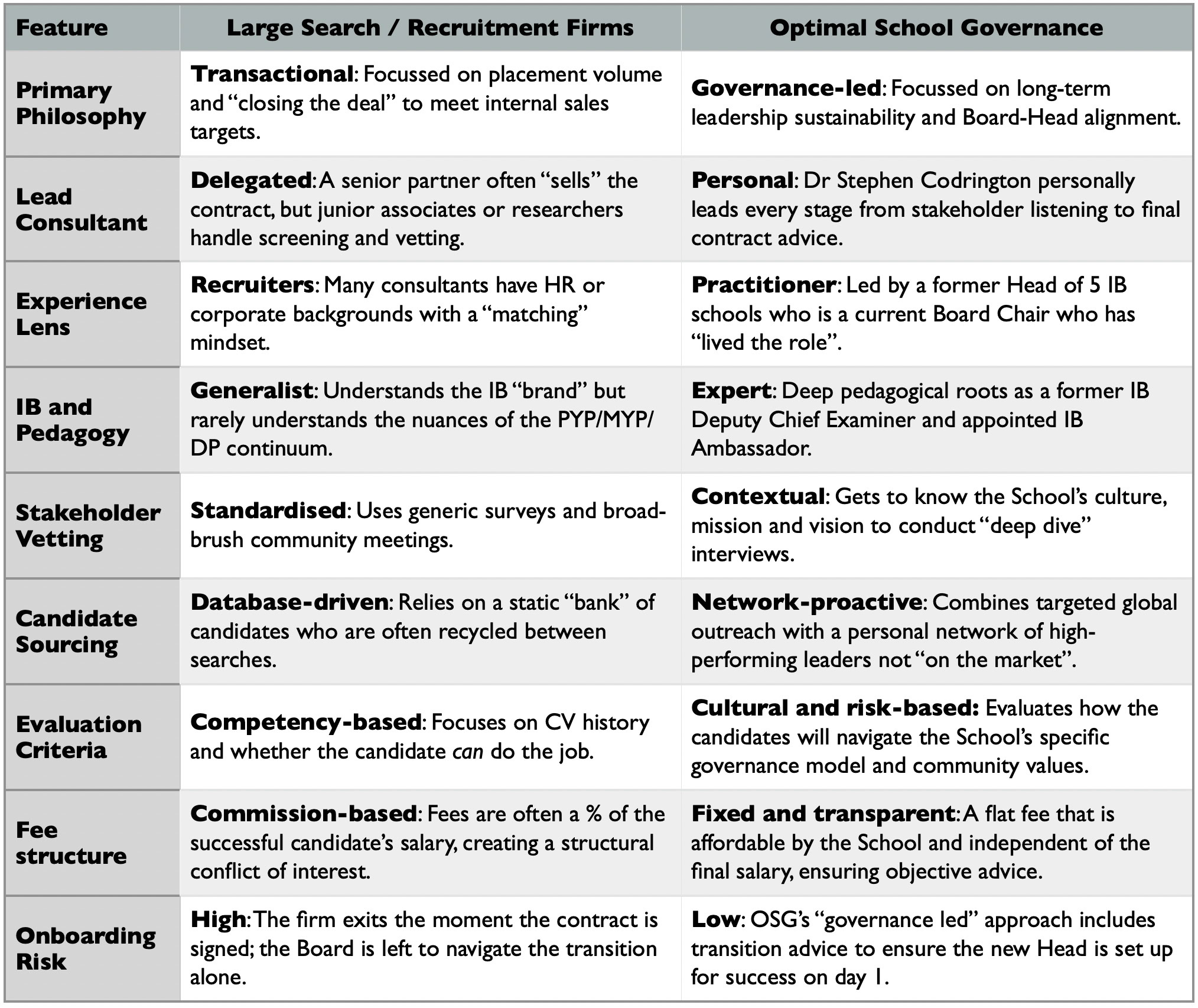
Footnote: Historically, Optimal School Governance has only conducted Head of School recruitments for existing and previous clients. We are now open to enquiries from all international and independent schools. Our work contrasts with large search firms in the following ways: