

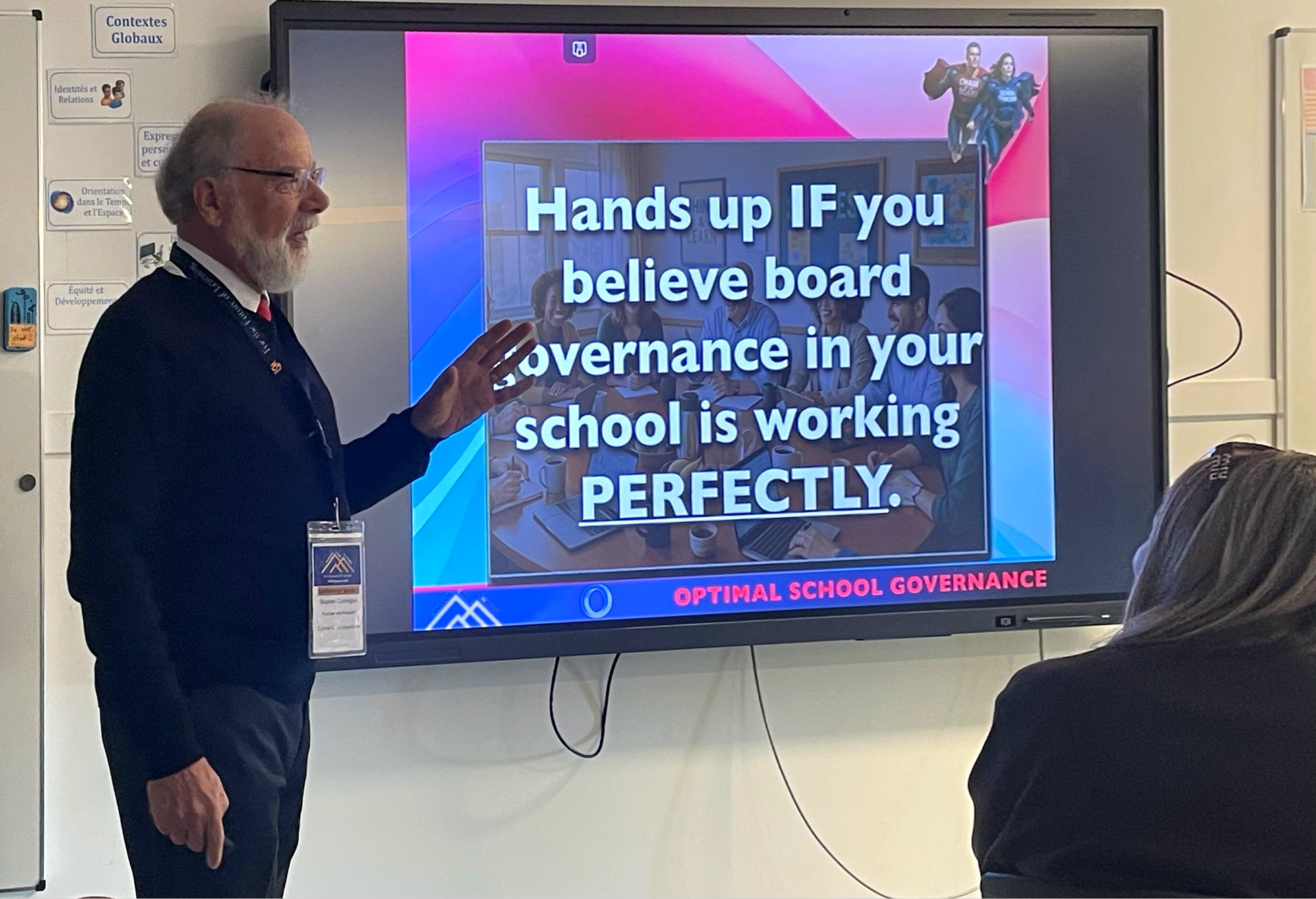
Earlier this month (January 2026) I had the privilege of presenting two sessions at an international conference of about 350 educators in Monaco. During each of my sessions, which explored optimising the board’s role in school leadership, I asked attendees to raise their hands if they believed board governance in their school was working perfectly.
Not one hand was raised, even by those attendees who were board members or board chairs themselves.
This result suggests that schools in general don’t merely have a board problem, they have a board crisis given the pivotal role that boards should play in steering their school’s direction and supporting their staff, their students, their senior leaders and the wider school community. Most of the attendees were from schools in Europe, and there was also significant representation from the Middle East and Central Asia. There is no reason to believe that the results would be different in Africa, Asia, Australia or the Americas.
Later in each of my sessions I gave attendees an anonymous opportunity to use up to five one-word responses to describe their board. As they entered their responses, I activated software to generate a word cloud on-the-spot so everyone could see the shared perspectives.

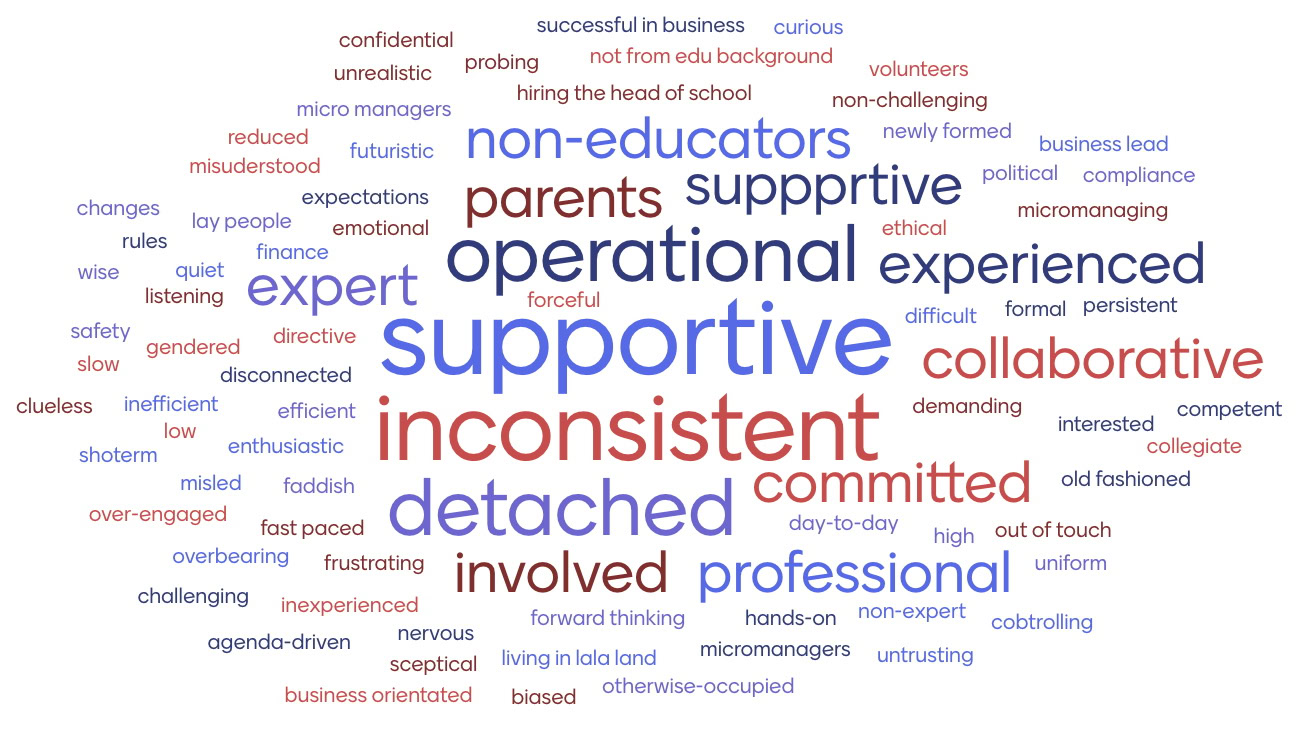
As you can see in the word cloud that was generated, senior leaders in schools across multiple locations have widely diverse experiences with their boards. Although “supportive” was the most common word used, being provided by 18% of respondents (or 21% if we include several who typed “suppprtive”), it is fair to say that most responses fell a long way short of expressing ecstatic enthusiasm for their boards, and on balance there were more negative words than positive.
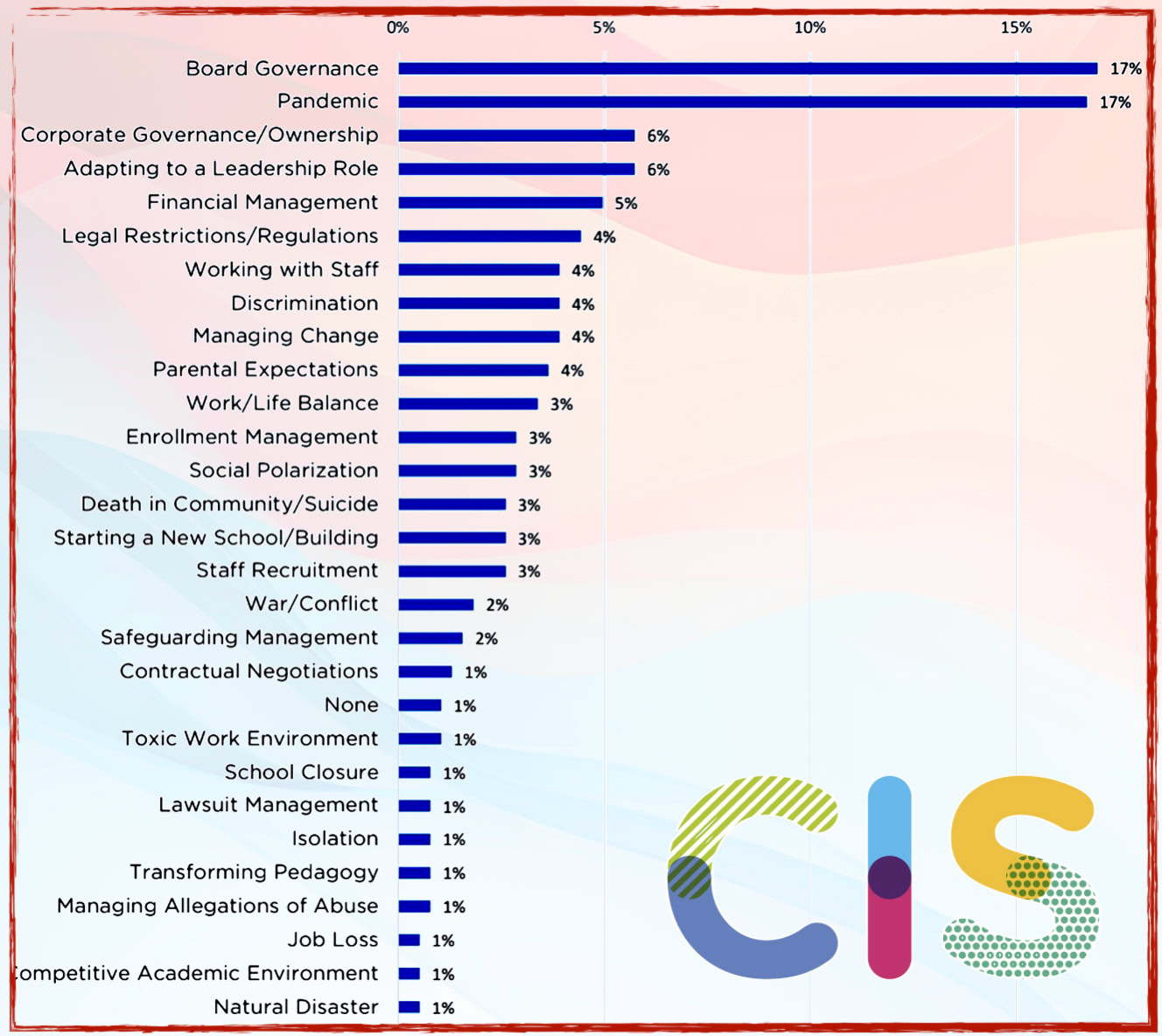
That is a disappointing news, but perhaps it should not be surprising. Each year, the Council of International Schools (CIS) conducts a global survey of Heads of its member schools. In the recently released 2025 survey, one of the questions was “What is the biggest professional challenge you have experienced in your career?” Almost 500 Heads from 103 countries responded and the top answer was “school governance”. A graph of the results is shown below.
Even before the two factors embracing governance (“Board Governance, 17.2%” and “Corporate Governance/Ownership, 6.0%”) are combined, we can see that governance presented a greater professional challenge to Heads of Schools than a global pandemic (16.8%).
Just reflect on that for a minute. School governance presents a greater professional challenge to Heads of Schools than the threat of a global pandemic!
In the many one-on-one conversations I had during the conference, I learned that most Heads regard their board members as well-meaning, but often woefully uninformed (or untrained) about the role and duties of a school board and its members. They felt many board members were over-worked to the point of burnout because they were spending so much time and effort unproductively and inefficiently. There was a widespread feeling that many board members didn’t really understand the ways in which school cultures differed from elsewhere, such as the corporate sector. Frustratingly, some Heads felt they had board members who had become complacent by creating and then slipping into comfort zones that added little or no value to the board.
These findings help to explain why I am passionate about the work I do globally with school boards and their senior leaders. Robust board governance is arguably the single most important and necessary factor required to build success in a school, but it is usually also one of the most neglected when it comes to professional development and capacity building.
For the sake of the future of our society and the young people in schools who will one day lead that society, school boards have a duty to improve their quality and increase the value they add to their schools.
We offer support for school leaders and board members in many areas, including workshops, strategic planning, board performance reviews, school climate surveys, Head of School recruitment, and lots more.
Further information on this and many other facets of best practice in school leadership and governance is provided in the books “Optimal School Governance", and “DARING INSIGHTS into School Leadership and Board Governance”, which can be ordered directly through Pronins.
You may also be interested in previous articles which are archived at https://optimalschool.com/articles.html. You can subscribe to receive future articles by e-mail using the red button below.